The Real Difference Between Saving and Investing (And Why It Matters in 2026)
Most people treat saving and investing like they’re the same thing — but mixing them up could be quietly costing you thousands of dollars. Understanding the difference between saving and investing is one of the most important money lessons you can learn in your 20s or 30s, and it’s a lot simpler than you might think.
What Is Saving, Exactly?
Saving means setting aside money in a safe, accessible place — typically a bank account — where the goal is to protect it rather than grow it dramatically. Think of it as your financial safety net.
Common places people save money include:
- High-yield savings accounts (HYSAs) — These pay interest (usually 4–5% APY in 2026) while keeping your money liquid
- Checking accounts — Easy access, but often little to no interest
- Money market accounts — A hybrid option with slightly higher rates and limited transactions
- Certificates of deposit (CDs) — Fixed-term savings with a locked-in interest rate
The key characteristics of saving are low risk, high liquidity (meaning you can access the money quickly), and predictable returns. You know exactly what you’re getting.
Saving is best used for short-term goals — building an emergency fund, saving for a vacation, a car down payment, or any expense you expect to need within the next one to three years.
What Is Investing, Exactly?
Investing means putting your money into assets that have the potential to grow significantly over time — but with the trade-off that you could also lose some or all of it. The goal is wealth building, not just preservation.
Common investment types include:
- Stocks — Ownership shares in a company
- Bonds — Loans to governments or corporations that pay interest
- Index funds and ETFs — Diversified baskets of assets, often recommended for beginners
- Real estate — Property bought to generate rental income or appreciation
- Retirement accounts (401k, Roth IRA) — Tax-advantaged accounts that hold investments
The defining features of investing are higher potential returns, longer time horizons, and real risk of loss. The stock market has historically returned around 7–10% annually after inflation, but it fluctuates — sometimes dramatically — in the short term.
Investing works best for long-term goals: retirement, building generational wealth, or anything at least five or more years away.
The Core Difference Between Saving and Investing
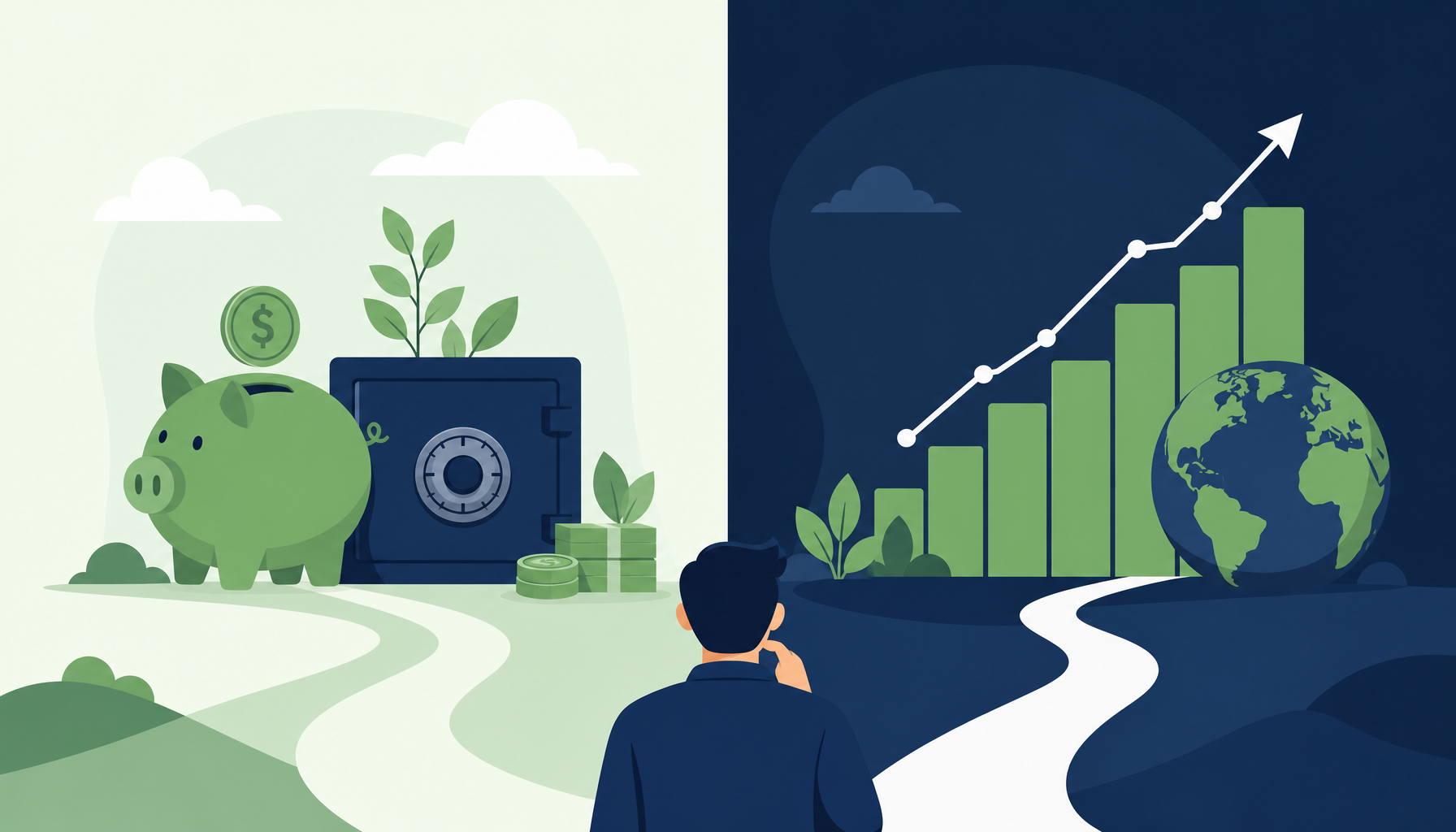
Here’s the simplest way to think about it: saving protects money, investing grows money.
| Saving | Investing | |
|---|---|---|
| Risk | Very low | Low to high |
| Return | 1–5% typically | 7–10%+ historically |
| Liquidity | High | Medium to low |
| Best for | Short-term goals | Long-term goals |
| Common accounts | HYSA, CD, money market | Brokerage, Roth IRA, 401k |
Another key difference is how they respond to time. Savings accounts earn interest at a slow, steady pace. Investments benefit from compound growth — where your returns generate their own returns — which becomes exponentially more powerful the longer you stay invested.
For example, $5,000 saved in a high-yield savings account at 4.5% APY grows to about $6,200 after five years. That same $5,000 invested in a diversified index fund at an average 8% annual return could grow to over $7,300 in five years — and over $23,000 in 20 years.
That gap is why understanding the difference between saving and investing isn’t just academic. It’s the difference between keeping up with inflation and actually building wealth.
When Should You Save vs. Invest?
This is the question most people actually need answered, and the honest answer is: you should usually do both at the same time, just with different money.
Save first when:
- You don’t yet have an emergency fund (aim for 3–6 months of expenses)
- You have high-interest debt, like credit card balances above 7–8%
- You have a specific expense coming up within the next 1–3 years
- You need the money to be guaranteed and accessible
Invest when:
- Your emergency fund is solid
- Your high-interest debt is paid off or manageable
- You have money you won’t need for at least 5 years
- You want your money to outpace inflation over the long run
A common approach for young adults in 2026 is the “save first, invest the rest” method — automate your savings for your emergency fund and near-term goals, then funnel everything left over into a Roth IRA or index fund portfolio.
Common Mistakes People Make With Saving and Investing
Knowing the difference between saving and investing is one thing. Actually applying it correctly is another. Here are the most common mistakes to avoid.
Keeping everything in a savings account “just to be safe”
This feels responsible, but it’s actually a slow financial loss. Inflation in 2026 is running at roughly 3%, which means money sitting in a standard savings account earning 0.5% is losing purchasing power every single year. Investing the portion of your money that you don’t need in the short term is how you stay ahead of inflation.
Investing money you might need soon
Investing is a long game. If you throw your car repair fund or your rent money into the stock market and the market drops 20% right when you need that cash, you’re forced to sell at a loss. Only invest money you can leave untouched for years.
Waiting until you have “enough” to invest
Many people in their 20s put off investing because they think they need a big lump sum to get started. In 2026, apps like Fidelity, Vanguard, and Robinhood let you start investing with as little as $1. Time in the market almost always beats timing the market — so start now, even small.
Not knowing your account types
A savings account and an investment account are not the same thing. Neither is a checking account and a 401k. Understanding which account holds which type of money helps you stay organized and avoid accidentally spending money earmarked for long-term growth.
How to Know Where You Stand Financially
Before you can decide how much to save and how much to invest, you need a clear picture of your current financial situation — your income, debts, credit score, and monthly cash flow.
One of the easiest ways to get that overview for free is through Credit Karma. It gives you free access to your credit score and report, tracks your debts, and even shows you personalized financial recommendations based on your situation. For young adults just starting to build a financial foundation, it’s genuinely useful to have that full picture in one place before making any big decisions about where to put your money. You can sign up for free at Credit Karma and have your financial snapshot in minutes.
Once you know your numbers, it becomes much easier to figure out how much you can realistically put toward savings goals versus investments each month.
Building a Simple Saving and Investing Plan in 2026
You don’t need a financial advisor or a complicated spreadsheet to get started. Here’s a beginner-friendly framework:
Step 1: Build your emergency fund first
Open a high-yield savings account and automate contributions until you have 3–6 months of living expenses saved. This is your financial cushion — don’t skip it.
Step 2: Pay off high-interest debt
Any debt with an interest rate above 7–8% should be prioritized before aggressive investing, because the guaranteed “return” of eliminating that debt beats most investment returns.
Step 3: Contribute to tax-advantaged accounts
If your employer offers a 401k match, contribute at least enough to get the full match — it’s free money. Then open a Roth IRA and contribute up to $7,000 per year (the 2026 limit for those under 50).
Step 4: Invest in low-cost index funds
Inside your Roth IRA or a taxable brokerage account, invest in broad-market index funds like a total stock market ETF or an S&P 500 fund. Low fees, automatic diversification, and historically strong returns make these the go-to choice for most beginners.
Step 5: Automate everything
Set up automatic transfers so your savings and investment contributions happen on payday without any willpower required. Consistency over time is what builds real wealth.
Conclusion
The difference between saving and investing comes down to this: saving keeps your money safe and accessible for the near term, while investing grows your money over time for long-term goals. Both serve a purpose, and smart personal finance means using each one strategically.
In 2026, with inflation still a real concern and investment tools more accessible than ever, the best thing you can do is stop treating these two strategies as interchangeable. Start with your emergency fund, get a clear picture of your finances with a free tool like Credit Karma, then begin investing consistently — even if it’s just $25 a month to start.
The sooner you put the right money in the right place, the harder it works for you.
Frequently Asked Questions
Is saving or investing better for beginners?
Both matter, but the order is important. Beginners should start by building an emergency fund in a high-yield savings account, then begin investing once that cushion is in place. You don’t have to choose one — you can and should do both simultaneously once you have the basics covered.
Can you lose money saving vs. investing?
In traditional savings accounts, you won’t lose the principal amount — it’s FDIC insured up to $250,000. With investing, you can lose money, especially in the short term. However, historically, diversified long-term investors have seen strong positive returns over multi-decade periods.
What’s the difference between a savings account and an investment account?
A savings account is held at a bank and keeps your money safe with minimal interest. An investment account (like a brokerage account or Roth IRA) holds assets like stocks, bonds, and funds that fluctuate in value. They serve very different purposes and shouldn’t be confused.
How much should I save vs. invest each month?
A common rule of thumb is to save 20% of your income total — splitting that between short-term savings goals and long-term investments. A popular breakdown is 10% to an emergency fund or savings goals and 10% to investments, adjusting as your financial situation evolves.
Is a Roth IRA saving or investing?
A Roth IRA is an investment account with tax advantages — it’s not a savings account, even though some people use the term loosely. The money you put into a Roth IRA is invested in assets like index funds and stocks, and it grows tax-free. Contributions are made with after-tax dollars, and qualified withdrawals in retirement are completely tax-free.