How to Save for a Car in 2026 (Step-by-Step Guide for First-Time Buyers)
You want a car, but your bank account has other ideas. The good news? With the right plan, saving for a car in 2026 is completely doable — even if you’re starting from zero.
Whether you’re eyeing a brand-new ride or a reliable used car to get you to work, the process of saving up comes down to a few clear steps. This guide breaks it all down so you know exactly what to do next.
Figure Out How Much Car You Actually Need
Before you save a single dollar, you need a target number. And that means being honest about what kind of car fits your life — not just your wishlist.
In 2026, the average price of a used car sits around $28,000–$32,000, while new cars average closer to $48,000. But you don’t need to spend that much, especially if this is your first vehicle purchase. Plenty of reliable used cars are available in the $12,000–$18,000 range if you shop smart.
Here’s what to think about when setting your target:
- New vs. used: New cars come with warranties and lower maintenance risk, but used cars cost significantly less and depreciate slower from your purchase point.
- Cash vs. financing: Are you planning to pay in full or put down a deposit and finance the rest? Either way, you’ll need savings — either the full amount or a solid down payment (aim for at least 20%).
- Total cost of ownership: Factor in insurance, registration, gas, and maintenance. These can add hundreds of dollars per month on top of any car payment.
Once you have a number in mind, you have a real savings goal to work toward.
Check Your Credit Before You Do Anything Else
If you’re planning to finance part of your car purchase, your credit score is one of the most important numbers in this process. It determines your interest rate, which affects your monthly payment and total cost over the life of the loan.
A credit score of 700 or higher typically qualifies you for much better rates. Someone with a 620 score might pay 10–12% APR on an auto loan, while someone with a 750+ score could pay 5–6% or less. That difference adds up to thousands of dollars over a 48- or 60-month loan.
If you haven’t checked your credit recently, Credit Karma is a free tool that shows your credit score, credit report, and personalized tips for improving your score over time. It takes about two minutes to sign up, and it won’t hurt your credit to check. Use the time while you’re saving to also build your score — two goals at once.
Build a Dedicated Car Savings Fund
One of the biggest mistakes people make is trying to save for a car from their regular checking account. When the money sits alongside your everyday spending, it gets spent. The fix is simple: keep your car savings completely separate.
Open a high-yield savings account specifically for your car fund. In 2026, many online banks are still offering competitive APYs — some above 4% — which means your money actually grows while it sits there. Even on $5,000 in savings, that’s an extra $200 a year doing nothing but waiting.
Here’s how to set it up:
- Choose a high-yield savings account from an online bank (look for no monthly fees and a competitive APY).
- Name the account something motivating — “Car Fund” or “2027 Car” works great.
- Set up automatic transfers from your checking account on payday.
Automation is key. When money moves before you even see it, you won’t miss it. Treat your car savings like a bill you have to pay every month.
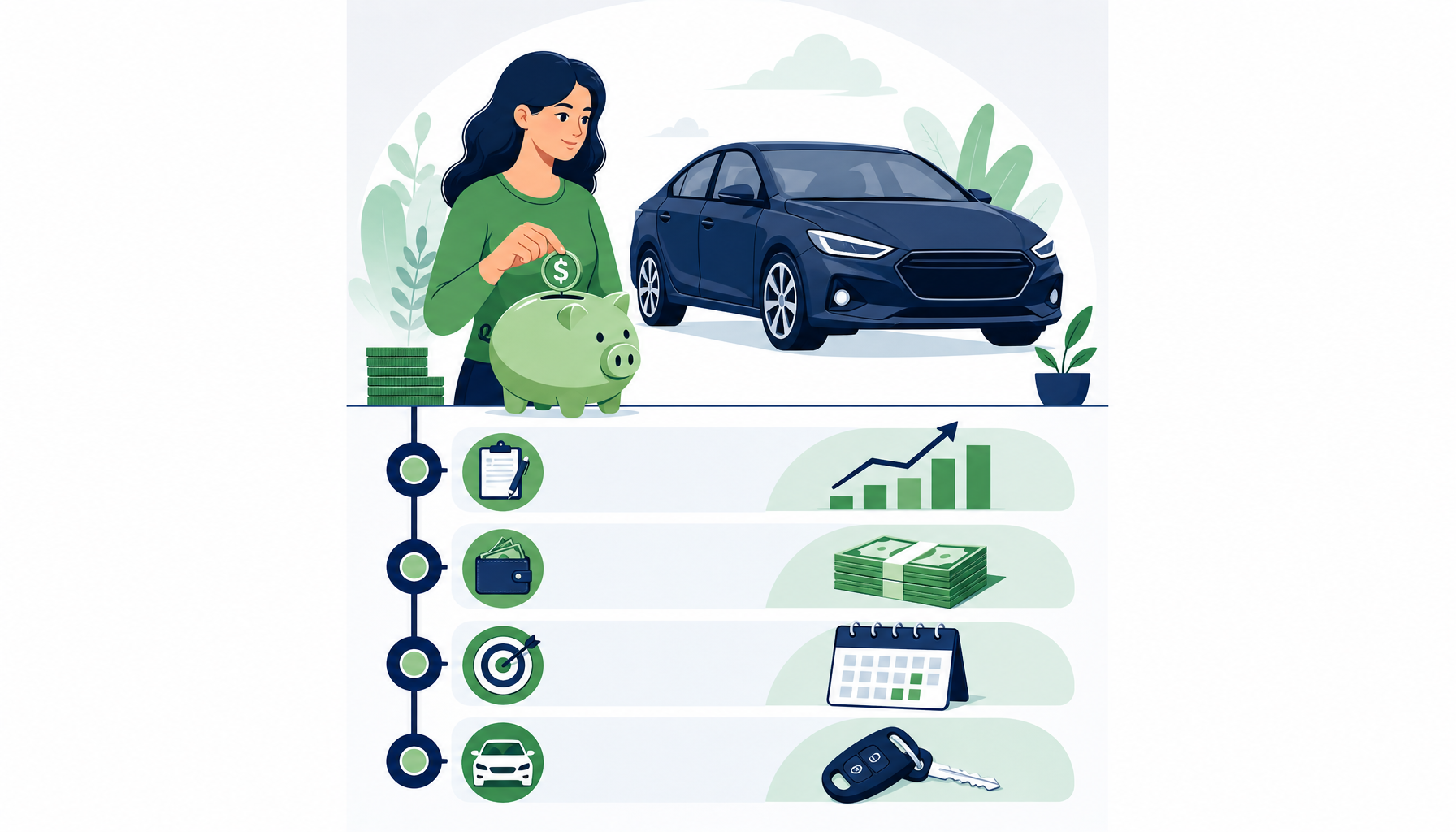
Create a Monthly Savings Timeline
Now that you have a goal and a dedicated account, it’s time to reverse-engineer your timeline. This is where most people skip a step, and then feel like they’re not making progress.
Let’s say you need $6,000 for a down payment on a used car. Here’s how long it takes depending on how much you save:
- $200/month → 30 months (~2.5 years)
- $400/month → 15 months (~1.25 years)
- $600/month → 10 months
- $1,000/month → 6 months
Pick a timeline that’s realistic for your income. If $400 a month feels tight, start with $200 and look for ways to increase it. A goal with a real timeline feels achievable. A vague goal like “save money for a car someday” almost never works.
If you don’t already have a monthly budget, now is the time to build one. Track your income, list all your fixed expenses (rent, utilities, subscriptions), and find the gap. That gap is your savings opportunity.
Find Ways to Speed Up Your Savings
If your current budget doesn’t leave much room to save, you have two levers to pull: spend less or earn more. Ideally, you do both.
Cut back on the obvious stuff first:
- Cancel subscriptions you don’t actively use
- Cook at home more often (even just 3 extra meals per week adds up)
- Pause lifestyle spending temporarily — think of it as trading short-term comfort for long-term independence
Boost your income:
- Pick up a side hustle like food delivery, freelancing, or selling stuff you don’t need
- Ask for more hours at work if that’s an option
- Sell items you own — electronics, clothes, furniture, sports gear
- Direct any windfalls (tax refund, birthday money, work bonus) straight into your car fund
In 2026, gig economy options are more accessible than ever. Even one or two extra shifts per week on a delivery app can add $200–$400 to your monthly savings without a major lifestyle overhaul. Apply that directly to your car fund and watch the number grow faster than you expected.
Avoid Common Saving Mistakes
Saving for a car sounds simple in theory, but there are a few traps that slow people down or derail them entirely.
Skipping the emergency fund: Before you dump everything into a car fund, make sure you have at least $1,000 set aside for emergencies. If something unexpected hits — a medical bill, a broken laptop, job instability — you’ll raid your car savings and feel like you’re starting over. Build a small emergency buffer first.
Saving while carrying high-interest debt: If you have credit card debt at 20%+ APR, you’re losing more to interest than you’re earning in savings. It may be smarter to pay down that debt aggressively first, then redirect those payments to your car fund. Run the math for your specific situation.
Setting a goal that’s too big too fast: It’s tempting to aim for the nicest car you can imagine, but a goal that feels out of reach leads to giving up. Start with a realistic first car — reliable, affordable, practical. You can upgrade later when your finances are stronger.
Not accounting for buying costs: When you hit your savings goal, you’ll also need money for taxes, registration fees, and possibly a first insurance payment. Budget an extra $500–$1,500 on top of your car price to cover these costs.
What to Do When You’re Ready to Buy
Getting close to your goal is exciting, but how you buy the car matters just as much as saving for it. A few smart moves can save you thousands.
Get pre-approved before you shop. If you’re financing, visit your bank or credit union before you go to a dealership. Pre-approval tells you exactly what rate you qualify for, which gives you negotiating power.
Shop used from private sellers or reputable dealerships. Private party sales are often thousands cheaper than dealership prices. Use resources like Carfax to check a vehicle’s history before buying.
Don’t let the monthly payment distract you from the total price. Dealers sometimes focus conversations on the monthly payment rather than the full cost of the car. Negotiate the purchase price first, then figure out financing.
Consider a certified pre-owned (CPO) vehicle. If you want a used car with some of the benefits of a new one — including a manufacturer warranty — CPO vehicles are a solid middle ground and often come with lower interest rates than standard used cars.
Stick to your budget. When you’re standing on a car lot, it’s easy to get talked into spending more than you planned. Knowing your hard limit before you walk in keeps you in control.
Conclusion
Saving for a car in 2026 takes a clear goal, a dedicated account, and consistent action every month. Set your target, check your credit, automate your savings, and look for ways to increase the pace. The process isn’t complicated — it just requires you to start and then keep going.
Your next step right now: open a high-yield savings account today, decide on a monthly transfer amount, and set up that automatic deposit before the week is over. Future you — the one with keys in hand — will be glad you did.
Frequently Asked Questions
How much should I save before buying a car?
If you’re financing, aim to save at least 20% of the car’s purchase price as a down payment. This lowers your monthly payment, reduces the total interest you pay, and keeps you from being “upside down” on your loan. If you’re paying in cash, your goal is the full purchase price plus $500–$1,500 for taxes and fees.
Is it better to save up and pay cash or finance a car?
Both options have merit depending on your situation. Paying cash means no monthly payment and no interest — which saves money long term. Financing allows you to get a car sooner while building credit history. If you can secure a low interest rate (under 5%) and have strong cash flow, financing can be a reasonable choice. If rates are high, saving more upfront is usually smarter.
How long does it take to save for a car?
It depends on your goal and how much you can set aside each month. Saving $400 per month toward a $6,000 down payment takes about 15 months. Saving for a full cash purchase of an $18,000 car at $600/month takes roughly 2.5 years. Use your specific numbers to set a timeline that’s realistic and motivating.
What’s the best account to save for a car?
A high-yield savings account is ideal. It keeps your car money separate from everyday spending, earns interest while you wait, and is easy to access when you’re ready to buy. Look for accounts with no monthly fees and a competitive APY — many online banks in 2026 still offer strong rates.
Does saving for a car affect my credit score?
Simply saving money doesn’t directly impact your credit score. However, if you plan to finance part of your purchase, your credit score will affect your loan terms. Use the time you’re saving to also monitor and improve your credit through free tools like Credit Karma, so you’re in the best position when you’re ready to apply for a loan.