How to Invest in Index Funds for Beginners: A Step-by-Step Guide for 2026
You don’t need a finance degree or a six-figure salary to start building real wealth — you just need the right starting point. In 2026, index fund investing remains one of the smartest, simplest moves a beginner can make, and this guide will walk you through every step.
What Is an Index Fund and Why Should You Care?
Before you invest a single dollar, it helps to understand exactly what you’re putting your money into. An index fund is a type of investment that tracks a specific market index — think the S&P 500, which represents 500 of the largest companies in the United States.
Instead of betting on one stock like Apple or Tesla, you’re spreading your money across hundreds or even thousands of companies at once. That diversification is what makes index funds such a powerful tool for beginners. If one company tanks, your entire portfolio doesn’t tank with it.
Here’s why this matters for you specifically: index funds are low-cost, low-maintenance, and historically strong performers. According to decades of market data, most actively managed funds — where human experts pick stocks — consistently underperform simple index funds over the long run. So you don’t need an expert. You need a plan.
How Index Funds Actually Make You Money
This is the part that trips people up, so let’s make it crystal clear. Index funds make money in two main ways:
Price appreciation: As the companies inside the fund grow and become more valuable, the fund’s price goes up. If you bought in at $50 per share and it rises to $80, you’ve made $30 per share.
Dividends: Many companies within an index pay dividends — small cash payments made to shareholders. Your index fund collects these and either pays them out to you or reinvests them automatically (which is almost always the smarter move when you’re young).
The real magic, though, is compound growth. When your earnings generate their own earnings over time, your money starts to snowball. A $5,000 investment made at age 22 could grow to well over $50,000 by retirement — without you adding another cent — assuming historical average market returns. The earlier you start, the more time compound interest has to do the heavy lifting.
Choosing the Right Type of Index Fund
Not all index funds are the same, and picking the right one matters. Here are the main types you’ll encounter as a beginner in 2026:
S&P 500 Index Funds: These track the 500 largest U.S. companies. They’re the most popular starting point for beginners and include brands you already know — Amazon, Microsoft, Google, and more. Popular options include funds from Vanguard (VOO), Fidelity (FZROX), and Schwab (SCHB).
Total Market Index Funds: These go broader than the S&P 500, covering small, mid, and large-cap U.S. stocks. More diversity, slightly more exposure to smaller companies with growth potential.
International Index Funds: Want exposure beyond the U.S.? International funds track markets in Europe, Asia, and emerging economies. A small allocation here can balance your portfolio.
Bond Index Funds: Bonds are lower-risk investments that provide stability. When you’re young, you likely don’t need many bonds, but as you get older, they become more important.
For most beginners in their 20s and early 30s, starting with an S&P 500 index fund or a total market fund is the safest, most straightforward move.
Where to Open an Account and Buy Index Funds
You can’t buy an index fund without a brokerage account. Think of a brokerage as the platform that connects you to the stock market. The good news: opening one takes about 15 minutes and most have no minimums to get started.
Best Brokerage Options for Beginners in 2026
Fidelity — Consistently ranked as one of the best brokerages for beginners. They offer zero-expense-ratio index funds, no account minimums, and a clean interface that doesn’t overwhelm you.
Vanguard — The original home of index fund investing. Slightly more old-school interface, but ideal if you’re committed to a long-term, hands-off strategy. Their funds are legendary in the investment world.
Charles Schwab — Great all-around option with fractional shares, no minimums, and solid customer support for new investors.
Robinhood — Popular with younger investors for its simplicity. Fractional shares mean you can buy into an index fund with as little as $1. Just be aware it’s more of a starter platform.
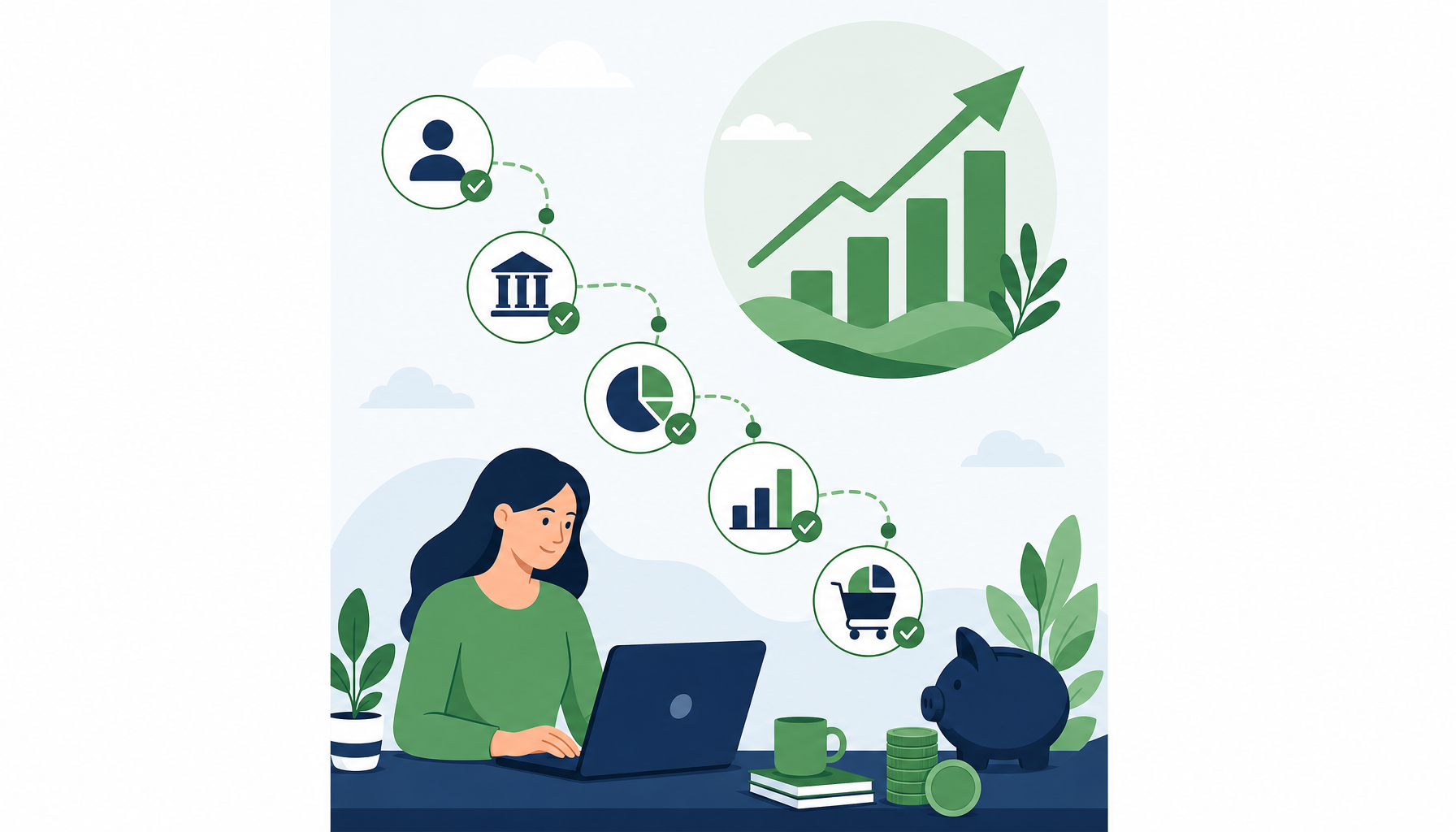
Once you choose a brokerage, you’ll create an account, verify your identity, and link your bank account. From there, you search for the index fund you want, enter how much you’d like to invest, and confirm. That’s genuinely it.
Should You Use a Regular Brokerage or a Retirement Account?
This is an important decision. A Roth IRA is one of the best accounts for young investors because your money grows tax-free. In 2026, you can contribute up to $7,000 per year to a Roth IRA if you’re under 50. If your employer offers a 401(k) with matching contributions, prioritize that first — it’s free money.
For money you might need before retirement, use a regular taxable brokerage account. Many beginners use both.
How Much Should You Invest to Start?
One of the biggest myths about investing is that you need a lot of money to begin. You don’t. Thanks to fractional shares, you can start with $5, $10, or $25 — whatever fits your budget right now.
A practical beginner framework looks like this:
- Step 1: Build a small emergency fund first (1–3 months of expenses before you invest aggressively)
- Step 2: Contribute enough to your 401(k) to get the full employer match
- Step 3: Open a Roth IRA and start investing in an index fund
- Step 4: Set up automatic contributions — even $50 a month makes a real difference over time
Consistency beats timing every single time. Don’t try to wait for the “perfect” moment to invest. Studies repeatedly show that time in the market beats timing the market. Someone who invested $200 a month starting at 23 will almost always outperform someone who waited until 30 to invest $500 a month.
Before you start investing, it’s also worth understanding your overall financial picture — including your credit score, which affects loan rates, housing costs, and more. Credit Karma is a free tool that lets you check your credit score and monitor your credit report without impacting your score. Getting a clear view of your finances before you invest helps you make smarter decisions about how much you can confidently put away each month.
Common Mistakes Beginners Make (And How to Avoid Them)
Even with a simple strategy, beginners trip up in predictable ways. Here’s what to watch for:
Panic selling during market dips. Markets drop. Sometimes dramatically. In 2022, the S&P 500 fell nearly 20%. In 2020, it crashed more than 30% in weeks. Both times, it recovered and hit new highs. If you sell when prices fall, you lock in losses. If you hold — or better yet, buy more — you benefit when the market bounces back.
Checking your portfolio obsessively. Your index fund is designed to be a long-term investment. Checking it daily causes anxiety and tempts you to make emotional decisions. Check in quarterly at most.
Choosing funds with high expense ratios. An expense ratio is the annual fee a fund charges. Even a 1% fee sounds small, but over 30 years it can cost you tens of thousands of dollars in lost growth. Look for expense ratios below 0.10%. Many major index funds are at 0.03% or even 0%.
Skipping tax-advantaged accounts. Investing in a taxable account before maxing out your Roth IRA or 401(k) is a common rookie mistake. Use those tax advantages first.
Overcomplicating it. You don’t need 12 different funds. A single S&P 500 index fund is a legitimate, effective strategy for most young investors. Keep it simple until you understand more.
Building a Long-Term Habit Around Investing
Investing in index funds isn’t a one-time event — it’s a habit you build over years. The investors who come out ahead aren’t the ones who made the cleverest moves. They’re the ones who stayed consistent, automated their contributions, and didn’t panic when things got rocky.
Here’s how to set yourself up for success:
Automate everything. Set up automatic contributions from your paycheck or bank account directly into your index fund. When it happens automatically, you never miss the money.
Increase contributions when you get a raise. Lifestyle inflation is real — when you earn more, you spend more. Make a rule: every time your income goes up, increase your investment amount by at least half of the raise.
Educate yourself gradually. You don’t need to master everything at once. Start simple, get comfortable, then slowly learn more about asset allocation, tax strategies, and rebalancing over time.
Track your net worth, not just your portfolio. Your index fund is one piece of the puzzle. Knowing your full financial picture — income, debts, savings, investments — gives you clarity and motivation.
Conclusion
Investing in index funds as a beginner in 2026 is genuinely one of the best financial decisions you can make right now. The barrier to entry has never been lower, the tools have never been more accessible, and the strategy has been proven over decades of market history.
Your next step is simple: pick one brokerage from the list above, open a Roth IRA or brokerage account today, and make your first investment in an S&P 500 index fund — even if it’s just $25. The hardest part isn’t the math or the strategy. It’s starting. Once you do, you’ll wonder why you waited.
Frequently Asked Questions
How much money do I need to start investing in index funds?
Most major brokerages in 2026 have no minimum investment requirement. With fractional shares available on platforms like Fidelity, Schwab, and Robinhood, you can start with as little as $1. A good practical starting point is $25–$50 to build the habit.
Are index funds safe for beginners?
Index funds are considered one of the lower-risk investment options because they’re diversified across many companies. However, all investing carries risk — your investment can lose value in the short term. Index funds are best suited for money you won’t need for at least five years, ideally longer.
What is the best index fund for a first-time investor?
Most experts recommend starting with an S&P 500 index fund. Top picks in 2026 include Vanguard’s VOO, Fidelity’s FZROX (zero expense ratio), and Schwab’s SCHB. Any of these are solid choices for a beginner.
How long should I keep my money in an index fund?
Index funds perform best over long time horizons. A minimum of five years is generally recommended, but the longer the better. Investors who leave their money invested for 10, 20, or 30 years historically see the strongest returns thanks to compound growth.
Do I have to pay taxes on index fund earnings?
Yes, but how much depends on your account type. In a Roth IRA, your growth is tax-free at withdrawal. In a taxable brokerage account, you’ll owe capital gains taxes when you sell. Dividends are also taxable in a standard account. This is why maxing out tax-advantaged accounts first is such a smart strategy.