What Is Dollar Cost Averaging? The Beginner’s Guide to Investing Without the Stress
Most people avoid investing because they’re terrified of buying at the wrong time — but what if timing the market didn’t matter? That’s exactly the promise behind dollar cost averaging, one of the most beginner-friendly investing strategies you can start using today.
What Is Dollar Cost Averaging?
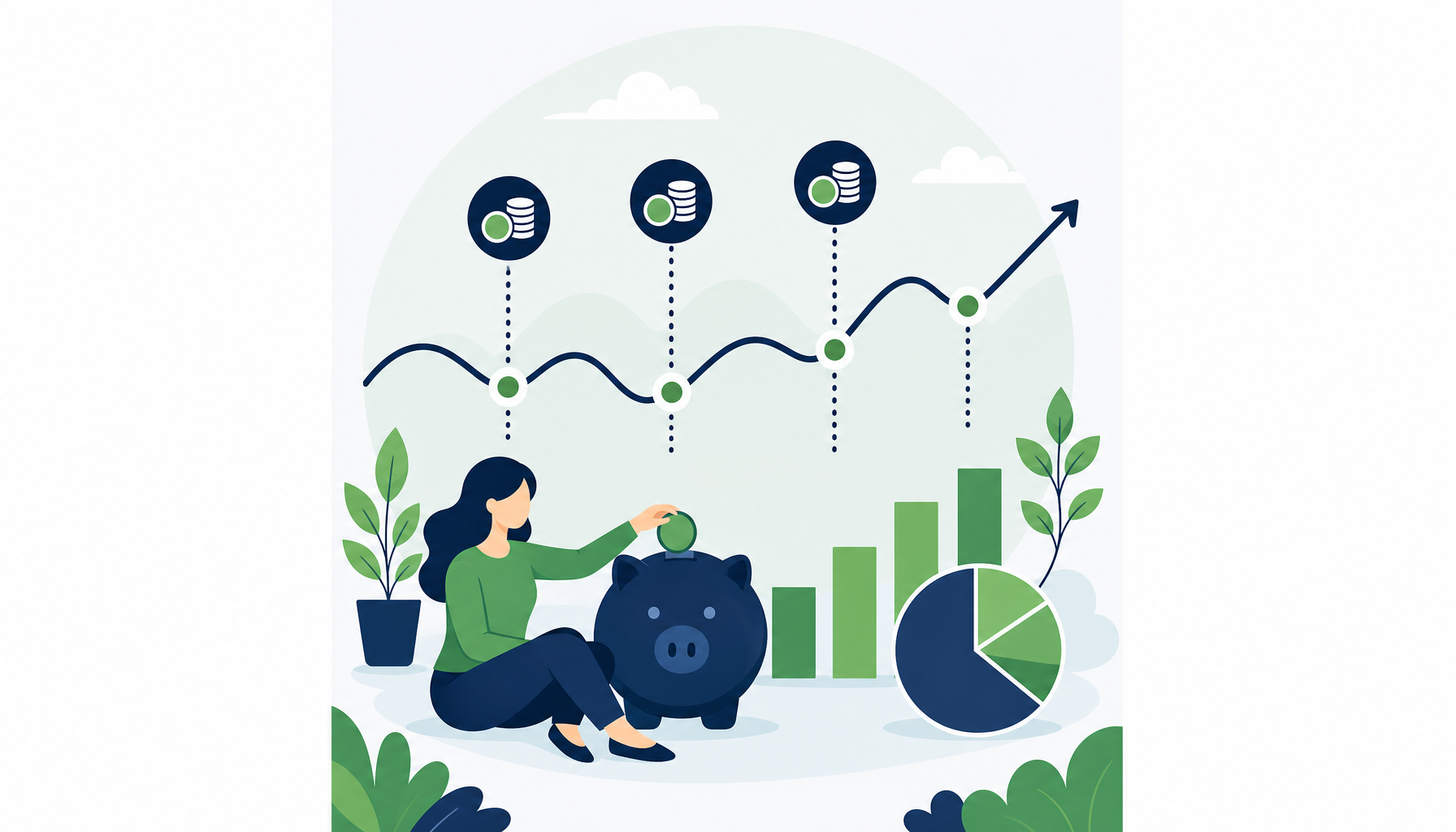
Dollar cost averaging (DCA) is an investment strategy where you invest a fixed amount of money at regular intervals — weekly, biweekly, or monthly — regardless of what the market is doing. Instead of trying to dump a lump sum in at the “perfect” moment, you spread your purchases out over time.
So instead of investing $1,200 all at once and hoping you picked a great day, you invest $100 every month for a year. Some months you’ll buy when prices are high. Some months you’ll buy when prices are low. Over time, your average cost per share tends to balance out — and that’s exactly the point.
The term “dollar cost” refers to the fact that your consistent dollar amount buys more shares when prices are low and fewer shares when prices are high. You’re not chasing the market. You’re working with it, steadily and systematically.
How Does Dollar Cost Averaging Actually Work?
Let’s make this concrete with a simple example. Imagine you invest $200 every month into an index fund.
- Month 1: Share price is $20. You buy 10 shares.
- Month 2: Share price drops to $10. You buy 20 shares.
- Month 3: Share price rises to $25. You buy 8 shares.
After three months, you’ve invested $600 total and own 38 shares. Your average cost per share is about $15.79. But if you had tried to time the market and bought all $600 in Month 1 at $20 per share, you’d only own 30 shares.
That’s the power of DCA in action. The dip in Month 2 actually worked in your favor because you were buying consistently. With a lump sum investment, that same dip would have just hurt you — at least on paper.
In 2026, many investing apps like Fidelity, Charles Schwab, and Vanguard make it incredibly easy to automate this process. You link your bank account, set a recurring transfer, choose your investment, and let it run. You don’t even have to think about it after setup.
Why Dollar Cost Averaging Is Perfect for Beginners
If you’re 18–35 and just starting out, the stock market can feel like a casino. Headlines scream about crashes. Social media influencers hype volatile crypto plays. It’s easy to feel like investing is something only finance bros with Bloomberg terminals can do well.
Dollar cost averaging cuts through all of that noise for a few key reasons.
You don’t need a large lump sum. You can start with as little as $25 or $50 per month on most platforms. This makes DCA accessible even if you’re working a part-time job or paying off student loans.
It removes emotion from the equation. One of the biggest wealth-killers for new investors is panic selling when markets drop. With DCA, drops actually become opportunities — you’re buying more shares for the same amount of money.
It builds the investing habit. Automating contributions each month means you’re consistently investing before you even think about spending. Over months and years, those contributions compound into something real.
It protects you from your own timing mistakes. Even professional fund managers can’t consistently predict market movements. DCA keeps you from making catastrophic bets based on guesses.
Dollar Cost Averaging vs. Lump Sum Investing
This is a debate that comes up a lot, and honestly, both strategies have merit depending on your situation.
Research has generally shown that lump sum investing outperforms DCA about two-thirds of the time over long periods — because markets tend to go up over time, and the sooner your money is invested, the longer it has to grow. But here’s the catch: that assumes you have a lump sum ready to invest, the emotional discipline to watch it drop 20% right after you invest it, and the confidence to stay put.
For most people in their 20s and early 30s, those three conditions don’t apply. You’re probably not sitting on $10,000 in cash waiting to deploy it. You’re earning money regularly and trying to figure out what to do with it. DCA fits that reality perfectly.
The other major advantage of DCA over lump sum investing is psychological. In 2026, market volatility remains real — economic shifts, geopolitical events, and tech disruptions can cause sharp swings. If you invest a big chunk of money right before a downturn, it’s easy to panic and sell. Dollar cost averaging makes you less reactive because you’re already committed to a plan that accounts for ups and downs.
Where to Actually Use Dollar Cost Averaging
DCA works best with broadly diversified investments that are likely to recover and grow over long periods. Here are the most common places people apply this strategy:
Index funds and ETFs. These are the gold standard for DCA. Funds that track the S&P 500, total stock market, or international markets give you instant diversification. You’re not betting on one company — you’re betting on the broader economy.
Retirement accounts (401k and Roth IRA). If you have a 401k through work, you’re likely already doing DCA without knowing it. Every paycheck, a fixed percentage goes in automatically. A Roth IRA works the same way when you set up automatic monthly contributions. In 2026, the Roth IRA contribution limit is $7,000 per year (or $8,000 if you’re 50+), which breaks down to about $583 per month.
Taxable brokerage accounts. Once you’ve maxed out tax-advantaged accounts, a regular brokerage account lets you continue DCA with no contribution caps.
Cryptocurrency. Some people apply DCA to Bitcoin or Ethereum instead of (or in addition to) traditional assets. This is higher risk, but the same principle applies — buying consistently over time reduces the sting of volatility.
Before you start investing, though, it helps to understand where your overall financial health stands. Tools like Credit Karma can give you a free look at your credit score, credit report, and even personalized financial insights — all in one place. Getting a clear picture of your credit and debt situation before you start investing is a smart move, especially if you’re carrying high-interest debt that should be paid off first.
Common Dollar Cost Averaging Mistakes to Avoid
DCA is simple, but it’s not foolproof. Here are a few mistakes that can undermine your strategy.
Stopping contributions when the market drops. This is the opposite of what you should do. Market dips mean you’re buying more shares for the same money. Stopping during a dip locks in losses and defeats the purpose of DCA entirely.
Investing in individual stocks. DCA works because it’s applied to diversified investments over long periods. Using DCA to repeatedly buy shares in a single company concentrates your risk. If that company tanks, your DCA strategy won’t save you.
Not increasing contributions over time. If you start investing $50 per month at 22, that’s a solid habit. But as your income grows, your contributions should grow too. Revisit your contribution amounts at least once a year.
Treating DCA as a forever set-it-and-forget-it. Automation is great, but you still need to periodically check that you’re invested in the right funds for your goals and risk tolerance. A 25-year-old and a 34-year-old may have different portfolio allocations even if they’re both using DCA.
How to Get Started with Dollar Cost Averaging in 2026
Getting started is simpler than most people think. Here’s a straightforward path:
- Decide how much you can invest each month. Even $50 matters. Aim to invest before spending — treat it like a bill.
- Choose your account. Start with a Roth IRA if you have earned income. Otherwise, open a taxable brokerage account.
- Pick your investment. A simple S&P 500 index fund or total market ETF is a strong starting point.
- Automate it. Set up a recurring monthly transfer and investment so you don’t have to think about it.
- Leave it alone. Don’t obsessively check your balance. Check in quarterly or when your life circumstances change.
The best time to start was years ago. The second best time is right now, in 2026, while you still have decades of compounding ahead of you.
Conclusion
Dollar cost averaging isn’t glamorous. It won’t make you rich overnight, and it won’t give you a story to brag about at dinner. What it will do is build real, sustainable wealth over time through consistency, discipline, and the power of compounding.
If you’re a young adult trying to figure out this whole money thing, DCA gives you a framework that’s simple, automated, and proven. You don’t need perfect timing. You don’t need a financial advisor. You just need to start, stay consistent, and let time do the heavy lifting.
Your next step: Open a Roth IRA this week, pick a total market index fund, set up a $50–$100 monthly automatic contribution, and don’t touch it. That single action could be worth tens of thousands of dollars by the time you’re 40.
Frequently Asked Questions
Is dollar cost averaging a good strategy for beginners?
Yes, absolutely. Dollar cost averaging is one of the best strategies for beginners because it doesn’t require market expertise, works with small amounts of money, and removes the pressure of trying to time the market perfectly. It’s especially powerful when combined with a long investment timeline.
How much money do I need to start dollar cost averaging?
You can start with as little as $10–$25 per month on many platforms in 2026. The specific amount matters less than the consistency. Starting small and automating it is far better than waiting until you have a large sum.
Does dollar cost averaging work in a bear market?
Yes — in fact, a bear market (when prices are falling) can be an advantage for DCA investors. When prices drop, your fixed monthly contribution buys more shares. When the market eventually recovers, those cheaper shares grow in value. DCA turns downturns into opportunities rather than disasters.
Can I use dollar cost averaging for crypto?
Yes, many investors apply DCA to Bitcoin, Ethereum, and other cryptocurrencies. The strategy helps smooth out crypto’s extreme price swings. However, crypto carries significantly more risk than index funds, so it should represent only a small portion of your overall portfolio if you choose to include it.
What’s the difference between dollar cost averaging and a lump sum investment?
A lump sum investment means putting all your available money in at once. Dollar cost averaging spreads that investment over time through regular, fixed contributions. Lump sum investing tends to outperform DCA statistically over long periods, but DCA is often more practical and emotionally manageable for most young investors who are investing income as they earn it rather than deploying a large cash reserve.