Stocks vs Bonds Explained Simply: What Every Young Investor Needs to Know in 2026
If you’ve ever stared at a finance article and felt like it was written in another language, you’re not alone. Stocks and bonds are two of the most talked-about investments in the world, and understanding them is one of the most important money moves you can make in 2026.
Whether you have $50 or $5,000 to invest, knowing the difference between these two assets will help you make smarter decisions and build real wealth over time. Let’s break it all down in plain English — no finance degree required.
What Is a Stock, Really?
A stock is a tiny piece of ownership in a company. When you buy a share of stock, you become a partial owner — or shareholder — of that business. If the company grows and becomes more valuable, your shares go up in value too. If it struggles, your shares can lose value.
Think of it like this: imagine your friend starts a pizza shop and offers you 10% ownership in exchange for $1,000. If that shop takes off and becomes worth $20,000, your 10% stake is now worth $2,000. You doubled your money. That’s essentially how stocks work, just on a much bigger and more liquid scale.
Stocks are traded on stock exchanges like the New York Stock Exchange (NYSE) or NASDAQ. In 2026, you can buy stocks easily through apps like Robinhood, Fidelity, or Schwab, often with no trading fees. The appeal of stocks is their potential for high returns — historically, the U.S. stock market has averaged around 10% annual returns over the long term. The downside? They can be volatile, meaning their value can swing dramatically in a short period of time.
What Is a Bond, Really?
A bond is essentially a loan you give to a company or government. When you buy a bond, you’re lending money to that entity, and in return, they promise to pay you back with interest over a set period of time.
Here’s a simple example: the U.S. government issues a 10-year Treasury bond at 4.5% interest. You buy $1,000 worth. For the next 10 years, the government pays you interest — and at the end of those 10 years, you get your original $1,000 back. That regular interest payment is called a coupon, and it’s one of the main reasons people love bonds.
Bonds are considered safer than stocks because the repayment terms are agreed upon upfront. However, that safety comes at a cost — bonds typically offer lower returns than stocks over the long term. In 2026, with interest rates still elevated compared to the low-rate era of the early 2020s, bonds have become more attractive to investors looking for steady income.
Stocks vs Bonds: Key Differences at a Glance
Let’s put the biggest differences side by side so they really click:
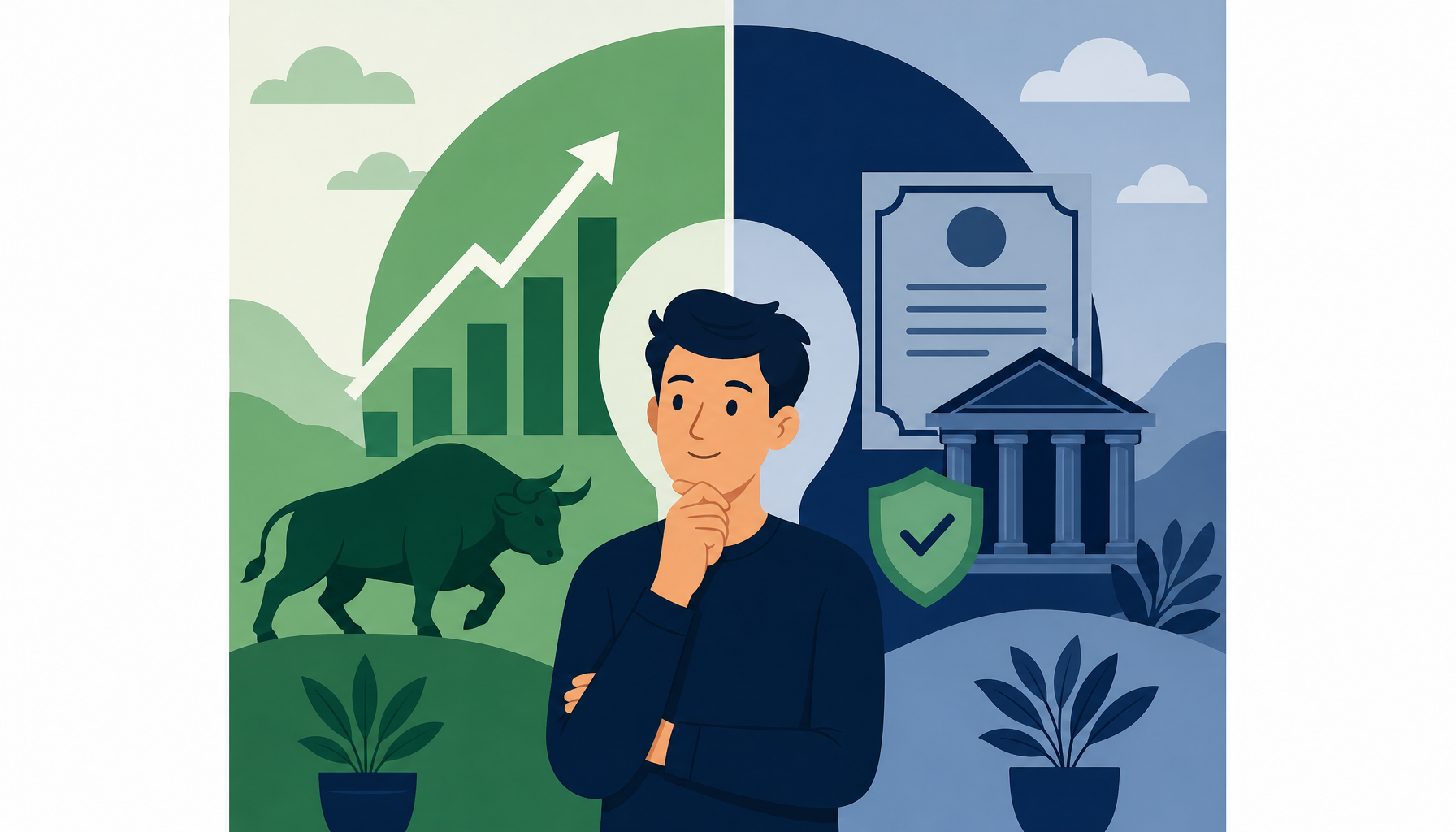
Ownership vs. Lending: Stocks make you an owner. Bonds make you a lender.
Risk Level: Stocks are higher risk with higher potential reward. Bonds are lower risk with more predictable returns.
Returns: Stocks have historically outperformed bonds over long time horizons. Bonds offer more stability but less upside.
Income: Some stocks pay dividends (a share of company profits), but not all. Bonds almost always pay regular interest.
Time Horizon: Stocks tend to shine over 10+ years. Bonds can work well for shorter-term goals or income needs.
Who They’re For: Stocks suit growth-oriented investors who can handle market swings. Bonds suit conservative investors or those nearing a financial goal.
Understanding these distinctions isn’t just trivia — it’s the foundation of how you’ll design your personal investment strategy.
How Risk and Return Actually Work
One of the most important concepts in investing is the risk-return tradeoff. Simply put, the more risk you take on, the higher your potential reward — but also the higher your potential loss.
Stocks sit on the riskier end of the spectrum. A single company’s stock can drop 50% in a year if the business hits hard times or the broader economy struggles. Remember 2022, when the S&P 500 dropped about 19%? That’s the kind of volatility stock investors have to stomach.
Bonds sit on the safer end. Because you’re a creditor (a lender) rather than an owner, you have a legal claim to be repaid before shareholders if a company goes bankrupt. This is called creditor priority, and it’s one reason bonds are less risky. However, bonds are not completely risk-free — if interest rates rise, existing bond prices fall, and if a company defaults entirely, you could still lose money.
For young investors in 2026, the key insight is this: time is your greatest asset. If you don’t need your money for 20 or 30 years, you can afford to ride out stock market volatility and potentially earn far greater returns. That’s why many financial advisors suggest that younger investors lean more heavily into stocks.
How to Build a Portfolio With Both
Most experienced investors don’t choose stocks OR bonds — they use both, in proportions that match their goals, timeline, and comfort with risk. This is called asset allocation, and it’s one of the foundational principles of smart investing.
A classic rule of thumb used to be “110 minus your age equals your stock allocation.” So if you’re 25, you’d put 85% in stocks and 15% in bonds. This formula is evolving as people live longer and need more growth to fund longer retirements, but it gives you a starting framework.
Here’s what a few sample portfolios might look like in 2026:
Aggressive (Age 22, long time horizon): 90% stocks, 10% bonds. Maximum growth potential with high short-term volatility.
Moderate (Age 30, saving for a home in 10 years): 70% stocks, 30% bonds. Balanced growth with some cushion.
Conservative (Age 34, building an emergency cushion): 50% stocks, 50% bonds. More stability, slower growth.
There’s no single right answer — the best portfolio is one you can stick to without panicking when markets dip.
The Role of Credit Health in Your Investment Journey
Before you dive into investing, there’s one thing that can supercharge or sabotage your financial future: your credit score. Bad credit can lock you out of favorable loan rates, hurt your ability to rent or buy a home, and make emergencies more expensive to handle.
This is where a tool like Credit Karma can be genuinely valuable. Credit Karma gives you free access to your credit score and credit report, along with personalized tips to help you improve your score over time. In 2026, it also offers features that help you track your financial progress and spot errors on your report that could be dragging your score down.
If you’re just starting your investing journey, take 10 minutes to check your credit health on Credit Karma before you allocate a single dollar. A strong financial foundation matters just as much as your investment strategy.
Common Mistakes Beginners Make With Stocks and Bonds
Even with the basics down, new investors often trip up in the same ways. Here’s what to avoid:
Going all-in on one stock. Putting all your money into a single company is gambling, not investing. Diversification — spreading your money across many investments — is how you manage risk. Index funds and ETFs make this easy.
Ignoring bonds entirely. Young investors sometimes dismiss bonds as “boring.” But having even a small bond allocation can reduce your portfolio’s volatility and help you stay calm during stock market drops.
Panic selling. Markets go up and down — that’s normal. Selling everything when prices drop locks in your losses. The investors who win long-term are usually the ones who stay the course.
Chasing last year’s winners. Just because a stock soared in 2025 doesn’t mean it will repeat that performance in 2026. Past performance is not a guarantee of future results.
Forgetting about taxes. Stock gains are taxable. Using tax-advantaged accounts like a Roth IRA or 401(k) can dramatically improve your long-term returns by shielding your gains from taxes.
Where to Start Investing in 2026
The good news? Getting started has never been easier or cheaper. Here’s a simple roadmap:
First, build a small emergency fund — ideally 3 to 6 months of expenses — before you invest. You don’t want to be forced to sell investments at a bad time because you need cash.
Second, if your employer offers a 401(k) with a match, contribute at least enough to get the full match. That’s free money, and it’s the best guaranteed return you’ll find anywhere.
Third, open a Roth IRA. In 2026, you can contribute up to $7,000 per year (or $8,000 if you’re 50 or older). Roth IRAs let your money grow tax-free, which is a massive long-term advantage.
Fourth, choose simple, diversified funds. Total market index funds or target-date funds give you instant exposure to both stocks and bonds without needing to pick individual securities.
Finally, automate your contributions. Set up automatic transfers so investing happens without relying on willpower or remembering to do it manually.
Conclusion
Stocks and bonds don’t have to be confusing. Stocks = ownership + growth potential + more risk. Bonds = lending + stability + lower returns. Together, they form the building blocks of almost every smart investment portfolio.
In 2026, you have access to better investing tools, more information, and lower fees than any generation before you. The biggest advantage you have is time — and the best time to start using it is right now.
Your next step: open a free account on Credit Karma to check your credit score and get your financial foundation solid, then look into opening a Roth IRA with a provider like Fidelity or Vanguard and make your first contribution this week. You don’t need a lot of money to start — you just need to start.
Frequently Asked Questions
Are stocks riskier than bonds?
Yes, generally speaking. Stocks can lose significant value in a short time, while bonds offer more predictable returns and greater legal protections if a company fails. However, stocks historically provide higher returns over long time periods, which is why they’re often recommended for younger investors with more time to ride out market swings.
Can you lose money on bonds?
Yes, you can. If you sell a bond before it matures, its market value may be lower than what you paid — especially if interest rates have risen. There’s also the risk of a bond issuer defaulting on their payments, though this is rare with government bonds.
How much of my portfolio should be in stocks vs bonds in 2026?
It depends on your age, goals, and risk tolerance. A common starting point for young adults is 80–90% stocks and 10–20% bonds. As you get older or get closer to a financial goal, gradually shifting more into bonds helps protect what you’ve built.
What’s the easiest way to invest in both stocks and bonds?
Target-date funds are one of the simplest options. You pick a fund based on the year you plan to retire — like a “2055 Fund” — and it automatically holds a mix of stocks and bonds that adjusts over time as you age. Many 401(k) plans offer these.
Do I need a lot of money to start investing?
Not at all. Many investment platforms in 2026 allow you to start with as little as $1 through fractional shares. The most important thing is to begin, even in small amounts, and build the habit of consistent investing over time.