How to Invest Your First $1000 in 2026 (A Beginner’s Step-by-Step Guide)
A thousand dollars might not sound like life-changing money, but how you invest it could absolutely change your life. In 2026, there are more accessible, beginner-friendly ways to put that first $1,000 to work than ever before — and getting started sooner matters more than getting it perfect.
If you’ve been sitting on some savings and wondering whether to invest, this is your sign. This guide breaks down exactly what to do with your first $1,000, step by step, without the jargon or the overwhelm.
Before You Invest: Make Sure You’re Actually Ready
Investing is exciting, but there are two financial boxes you need to check before you put a single dollar into the market.
Pay off high-interest debt first. If you’re carrying credit card balances with interest rates of 18–25% or higher, paying those off is essentially a guaranteed return. No investment consistently beats that. Your first $1,000 might be better used here.
Build a small emergency fund. You don’t need three to six months of expenses saved before you start investing — that’s a myth that keeps a lot of young people on the sidelines too long. But you should have at least $500 to $1,000 set aside for unexpected expenses so you don’t have to sell your investments at the worst possible time.
Once those two things are handled, you’re ready. Let’s get into it.
Understand What You’re Actually Trying to Do With This Money
Not all investment goals look the same, and knowing yours will determine where your money should go. Ask yourself honestly: what is this $1,000 for?
- Long-term wealth building (retirement, financial freedom in 20–30 years)
- Medium-term goals (buying a home in five to seven years, starting a business)
- Short-term goals (a vacation, a car, anything within one to three years)
Here’s the critical rule: money you need within the next one to three years should not go into the stock market. Markets can drop 20–30% or more in a short period, and you don’t want to be forced to sell during a downturn. For short-term goals, a high-yield savings account (HYSA) is a smarter move.
For medium and long-term goals, investing in the market makes a lot of sense — and that’s what the rest of this guide focuses on.
Open the Right Account First
Where you invest matters almost as much as what you invest in, because the account type determines your tax situation.
If you’re investing for retirement, open a Roth IRA. This is the single best account for most young adults in 2026. You contribute after-tax dollars, your money grows tax-free, and you pay zero taxes when you withdraw in retirement. In 2026, the contribution limit is $7,000 per year ($8,000 if you’re 50 or older). Your first $1,000 fits comfortably inside that limit.
If you’ve already maxed out your Roth IRA or you’re investing for a non-retirement goal, open a taxable brokerage account. You’ll owe taxes on gains, but there’s no contribution limit and no restrictions on when you can access the money.
Popular platforms for beginners include Fidelity, Charles Schwab, and Vanguard. All three offer zero-commission trades, no account minimums, and fractional shares — meaning you can invest in expensive stocks with as little as $1.
What to Actually Invest In: Keep It Simple
Here’s the thing most financial gurus won’t tell you: boring investing is winning investing. You don’t need to pick stocks, time the market, or follow trends on social media. For most beginners with $1,000, one of these three approaches works extremely well.
Option 1: A Total Stock Market Index Fund
A fund like FSKAX (Fidelity), SWTSX (Schwab), or VTSAX (Vanguard) gives you exposure to thousands of U.S. companies in a single investment. When you buy one share of a total market index fund, you own a tiny piece of Apple, Amazon, Microsoft, and thousands of smaller companies. The expense ratios on these funds are often as low as 0.03%, meaning you keep almost all of your returns.
Option 2: An S&P 500 Index Fund
Similar to a total market fund, but focused on the 500 largest U.S. companies. FXAIX, SWPPX, and VOO are popular options. Historically, the S&P 500 has returned an average of roughly 10% per year before inflation. That’s not guaranteed going forward, but it’s a strong long-term track record.
Option 3: A Target-Date Fund
If you want something completely hands-off, a target-date fund automatically adjusts its mix of stocks and bonds as you get closer to retirement. Pick the fund closest to the year you expect to retire (for example, a 2060 fund if you’re 25 in 2026), and the fund handles the rest. These are excellent inside a Roth IRA.
Avoid individual stocks, crypto, and options trading with your first $1,000. That doesn’t mean those things are always wrong — it means they’re not the right move for a beginner building a foundation.
How to Think About Risk at Your Age
One of the biggest advantages you have as a young adult is time. And time changes everything in investing.
If you’re 22 in 2026 and you invest $1,000 today, you have roughly 40 years until traditional retirement age. Over that time, even a market crash — the kind that makes headlines and causes panic — becomes a footnote. The stock market has recovered from every single crash in history, including the Great Depression, the 2008 financial crisis, and the COVID-19 crash of 2020.
That means you can afford to invest aggressively in stocks right now. A portfolio that’s 90–100% stocks makes sense for someone in their 20s or early 30s with decades ahead. As you get older and closer to needing the money, you gradually shift toward more conservative investments like bonds.
The worst thing a young investor can do is sell during a downturn out of fear. Markets drop. They always have. But if you don’t sell, a loss on paper eventually becomes a gain.
Build the Habit: What Comes After the First $1,000
Investing your first $1,000 is a milestone, but the real power comes from consistency. Here’s how to build on your momentum.
Set up automatic contributions. Most brokerages let you schedule recurring transfers from your bank account — even $25 or $50 per week adds up. Automating it removes the temptation to spend the money instead.
Use a budgeting tool to find more money to invest. This is where Credit Karma can genuinely help. Credit Karma offers free tools that let you track your spending, monitor your credit score, and spot areas where you might be overpaying — on insurance, credit cards, or subscriptions. When you cut unnecessary expenses, that found money can go straight into your investment account. It’s free to use and takes about five minutes to set up.
Reinvest your dividends. When your funds pay dividends, reinvest them automatically rather than cashing them out. This is called dividend reinvestment, and over time it significantly accelerates your growth through compounding.
Check in quarterly, not daily. Looking at your portfolio every day leads to emotional decision-making. Set a calendar reminder to review your investments every three months, rebalance if needed, and then step away.
Common Mistakes to Avoid With Your First $1,000
Even with the best intentions, beginners often trip up in predictable ways. Here’s what to watch out for.
Waiting for the “perfect” time to invest. There is no perfect time. People have been saying the market is about to crash for as long as markets have existed. Research consistently shows that time in the market beats timing the market.
Putting everything into one stock. It feels exciting to bet on a single company you believe in, but individual stocks carry enormous risk. Diversification through index funds protects you from any single company’s bad news wiping out your savings.
Checking your portfolio obsessively. Volatility is normal. A 10–15% swing in either direction is completely ordinary in a healthy market. Watching daily fluctuations leads to panic selling, which is the number-one way investors lose money.
Ignoring fees. Even small fees compound over time and eat into your returns. Stick with low-cost index funds with expense ratios below 0.20%. Avoid actively managed funds with fees of 1% or higher — the data shows they rarely outperform cheap index funds anyway.
Thinking $1,000 is too small to matter. It’s not. A 25-year-old who invests $1,000 today and never adds another dollar could have over $17,000 by age 65, assuming a 7% average annual return after inflation. Add consistent contributions on top of that, and the numbers become genuinely life-changing.
Conclusion: Your $1,000 Is Already Working for You
The best financial decision you’ll make in 2026 isn’t picking the hottest stock or finding the next big trend — it’s starting. Opening an account, investing that first $1,000 into a simple index fund, and building the habit of contributing regularly is a strategy that has made ordinary people wealthy over decades.
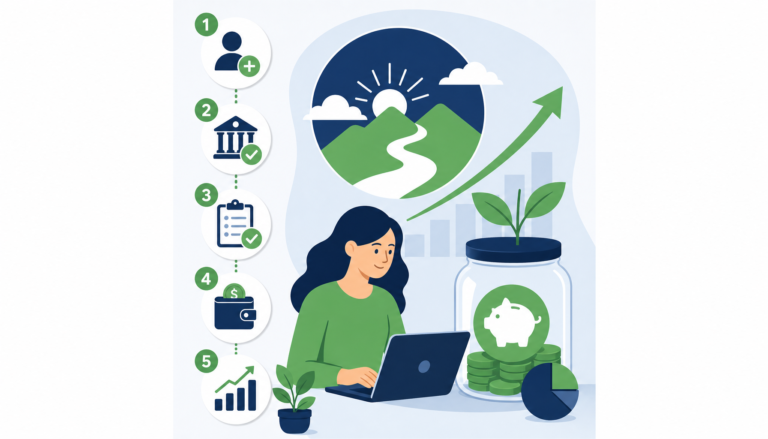
Your next step is simple: open a Roth IRA with Fidelity, Schwab, or Vanguard today. It takes about 10 minutes online. Transfer your $1,000, buy a total market or S&P 500 index fund, and set up an automatic monthly contribution for whatever amount you can afford. Then let time and compounding do the heavy lifting.
You don’t need more money, more knowledge, or more confidence. You just need to start.
Frequently Asked Questions
Is $1,000 enough to start investing?
Absolutely. Many brokerages in 2026 have no minimum account balance, and fractional shares let you buy into any fund or stock with as little as $1. A thousand dollars is more than enough to build a real investment portfolio.
Should I invest $1,000 all at once or spread it out?
Both strategies work. Investing it all at once (called lump-sum investing) tends to outperform spreading it out over time, according to multiple studies, because more money is exposed to market gains for longer. That said, if seeing a big drop right after you invest would cause you to panic and sell, spreading it out over two to three months can help you stay the course.
What’s the difference between a Roth IRA and a regular brokerage account?
A Roth IRA is a retirement account with tax-free growth — you pay no taxes on your gains when you withdraw in retirement. A regular (taxable) brokerage account has no contribution limits or withdrawal restrictions but doesn’t offer the same tax advantages. For most young adults, a Roth IRA should come first.
Can I lose all my money investing in index funds?
In theory, yes — if every company in the index went to zero simultaneously. In practice, that would mean the entire economy had collapsed, and cash wouldn’t be worth much either. Broadly diversified index funds are considered one of the safest long-term investments available.
What if I can’t afford to invest $1,000 right now?
Start with whatever you have. Even $100 gets you in the game, builds the habit, and teaches you how markets work. The amount matters far less than the consistency of contributing over time.